
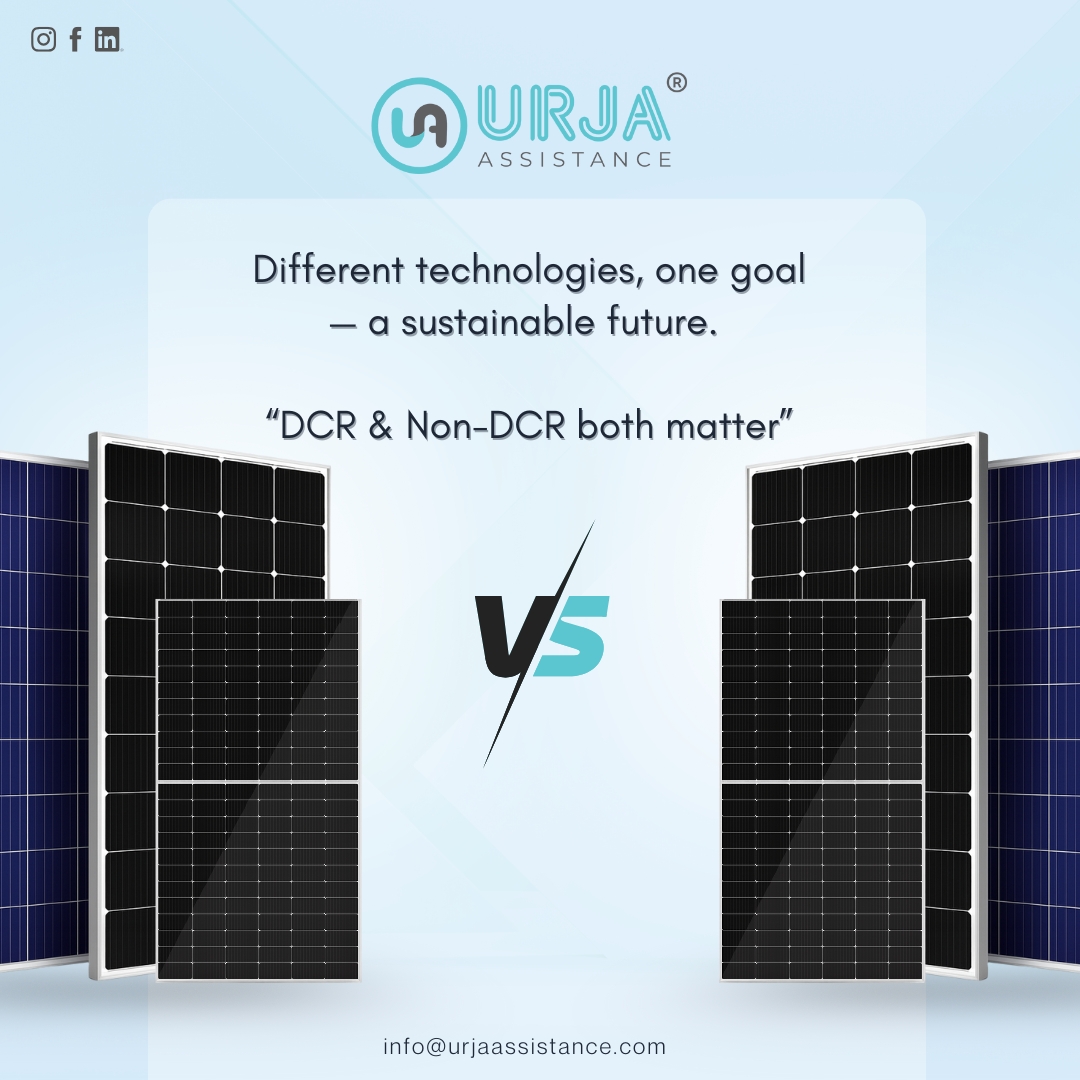
India’s solar mission is moving full steam ahead, with households, businesses, and industries switching to clean energy. But when it comes to choosing solar panels, many customers get confused between DCR (Domestic Content Requirement) panels and Non-DCR panels.
If you’re planning to install solar, understanding the difference can help you make the right decision for your budget, subsidy, and long-term savings.
What are DCR Solar Panels?
DCR panels are 100% “Made in India” solar modules where both the cells and modules are manufactured locally.
✔️ Eligible for Government Subsidy under the PM Surya Ghar Scheme
✔️ Support India’s Atmanirbhar Bharat initiative
✔️ Growing in quality and performance with domestic R&D
Best suited for: Homeowners applying for government rooftop solar subsidies.
What are Non-DCR Solar Panels?
Non-DCR panels are made with imported solar cells (mostly from countries like China, Vietnam, or Malaysia), while the final module assembly happens in India.
✔️ Lower cost compared to DCR
✔️ Often come with high efficiency due to advanced cell technology
✔️ Widely used in large-scale or commercial projects without subsidies
Best suited for: Businesses, Industries, or Households who don’t plan to apply for subsidies.
DCR vs. Non-DCR at a Glance
| Feature | DCR Panels | Non-DCR Panels |
| Manufacturing | Both cells & modules made in India | Cells imported, modules assembled in India |
| Eligibility for Subsidy | ✅ Eligible | ❌ Not eligible |
| Cost | Slightly higher | Comparatively lower |
| Quality & Efficiency | Good, improving with time | Sometimes higher due to advanced imported cells |
| Best For | Residential rooftop with subsidy | Large-scale/commercial projects without subsidy |
Which Should You Choose?
- Choose DCR if you want to apply for subsidy under the government’s rooftop solar scheme.
- Choose Non-DCR if you want cost efficiency for large projects where subsidies aren’t available.
Conclusion
Both DCR and Non-DCR solar panels play an important role in India’s solar journey. DCR supports local manufacturing and subsidies, while Non-DCR brings affordability and global efficiency standards.
Ultimately, the right choice depends on your project goals—subsidy-driven rooftop systems → DCR, cost-optimized large-scale projects → Non-DCR.
At Urja Assistance, we guide you through the best choice for your project—whether it’s residential, commercial, or industrial—ensuring maximum return on your solar investment.